From the fire to the fountain
History of the village
Down the centuries the name has been Cercelle, Churchell, Cherchell, and by 1537, Churchill. Sarsden is simpler: Sar’s dene, the valley belonging to Sar.
The name may come from Old English cyrc, a hill, burial ground or barrow. There are several barrows in the parish. Or it may be simply “hill-hill”: part Celtic, part Anglo-Saxon. The village is in Domesday, 1086: two mills, twenty-four villeins, fourteen families.
The fire of 1684
The original village stood at the foot of what is now Hastings Hill. On 31 July 1684 a fire destroyed twenty houses and many other buildings, and killed four people. Blame fell on a baker who, to avoid the chimney tax, had knocked through from her oven to her neighbour’s chimney.
The site was abandoned. Villagers rebuilt higher up the hill, in stone rather than timber. Only the graveyard, the chancel of the old church (now the Heritage Centre) and uneven ground in the adjoining field mark where Churchill used to be.
Sons of the village
Warren Hastings, first Governor-General of India, was born here on 6 December 1732, educated at the parish school, and later bought back the family estates at Daylesford. William Smith, “Strata Smith”, father of English geology, was born here on 23 March 1769, the son of a blacksmith, and as a young surveyor helped enclose Churchill and Sarsden.
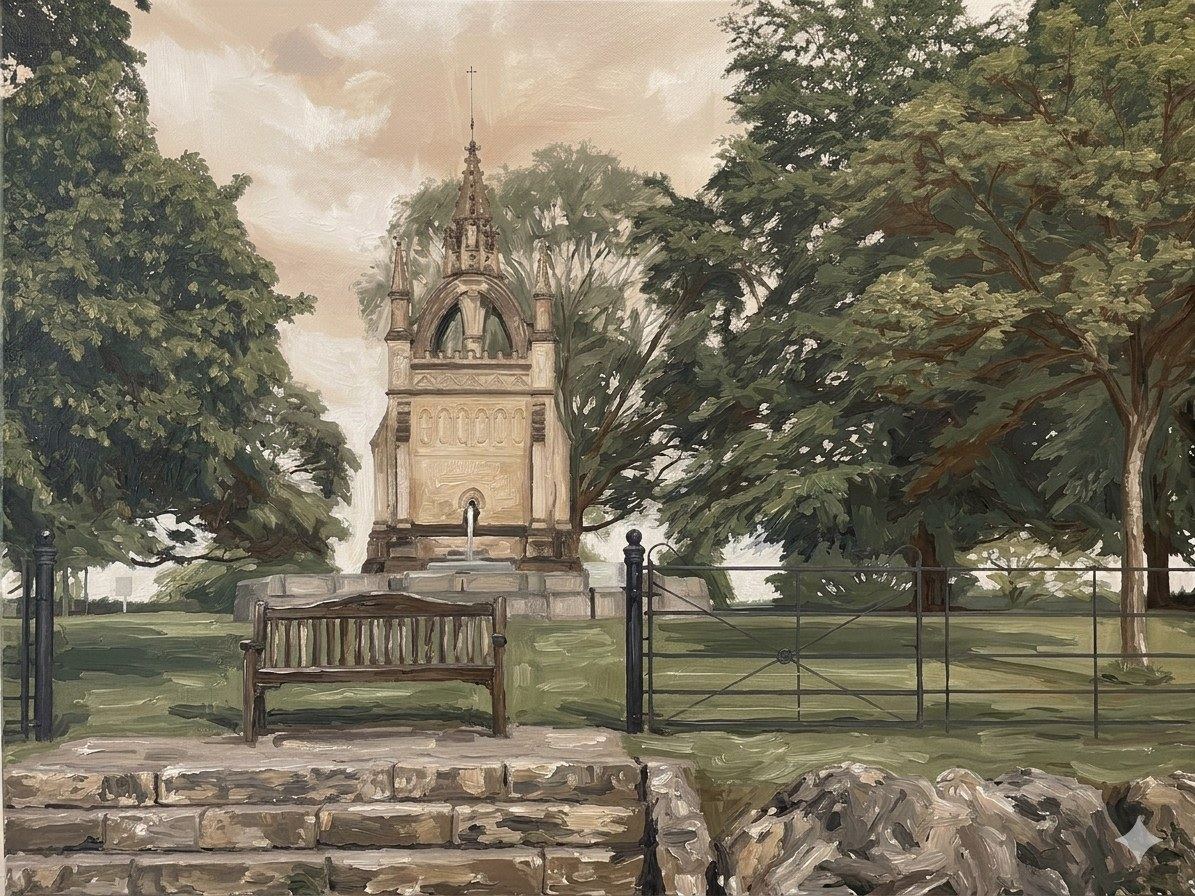
James Haughton Langston of Sarsden House rebuilt the church, and in 1870 his daughter Julia, Countess of Ducie, put up the memorial fountain on the green. Pevsner thought it “memorably ugly.” The village is rather fond of it.
For the full story, visit the Heritage Centre or obtain Ralph Mann’s History of Churchill and Sarsden.
On film
The Cotswold Explorer visits Churchill
A walk through the churchyard gates, the lost village, and the tower on the hill, filmed for Hidden Gems in the Cotswolds.